SmoothRide: An AI-powered Tool for Enhanced Citizen Engagement

"I want to help improve my city - but I don't know how or where to start."
That voice drives every design decision in SmoothRide. In a world where giving feedback on infrastructure often means navigating bureaucratic forms and waiting months for responses, we're creating something different: a platform that turns everyday experiences into collective urban intelligence.
The Participation Gap: When Democracy Feels Like Work
Traditional civic engagement suffers from what I call the "spreadsheet problem" - it's designed for administrators, not citizens. You need to know the right department, use the right terminology, and fill out the right forms. The result? Only the most persistent voices get heard, while everyday experiences get lost in bureaucracy.
This connects to themes I've explored before: the headphone pandemic that isolates us from our surroundings, car culture that shapes our cities around vehicles instead of people, and how cycling often feels like Type 2 or 3 fun in most places - an adventure rather than normal transport. Just as apartments make us apart our civic infrastructure makes participation feel distant and inaccessible.
From Complaint Box to Collaboration Platform
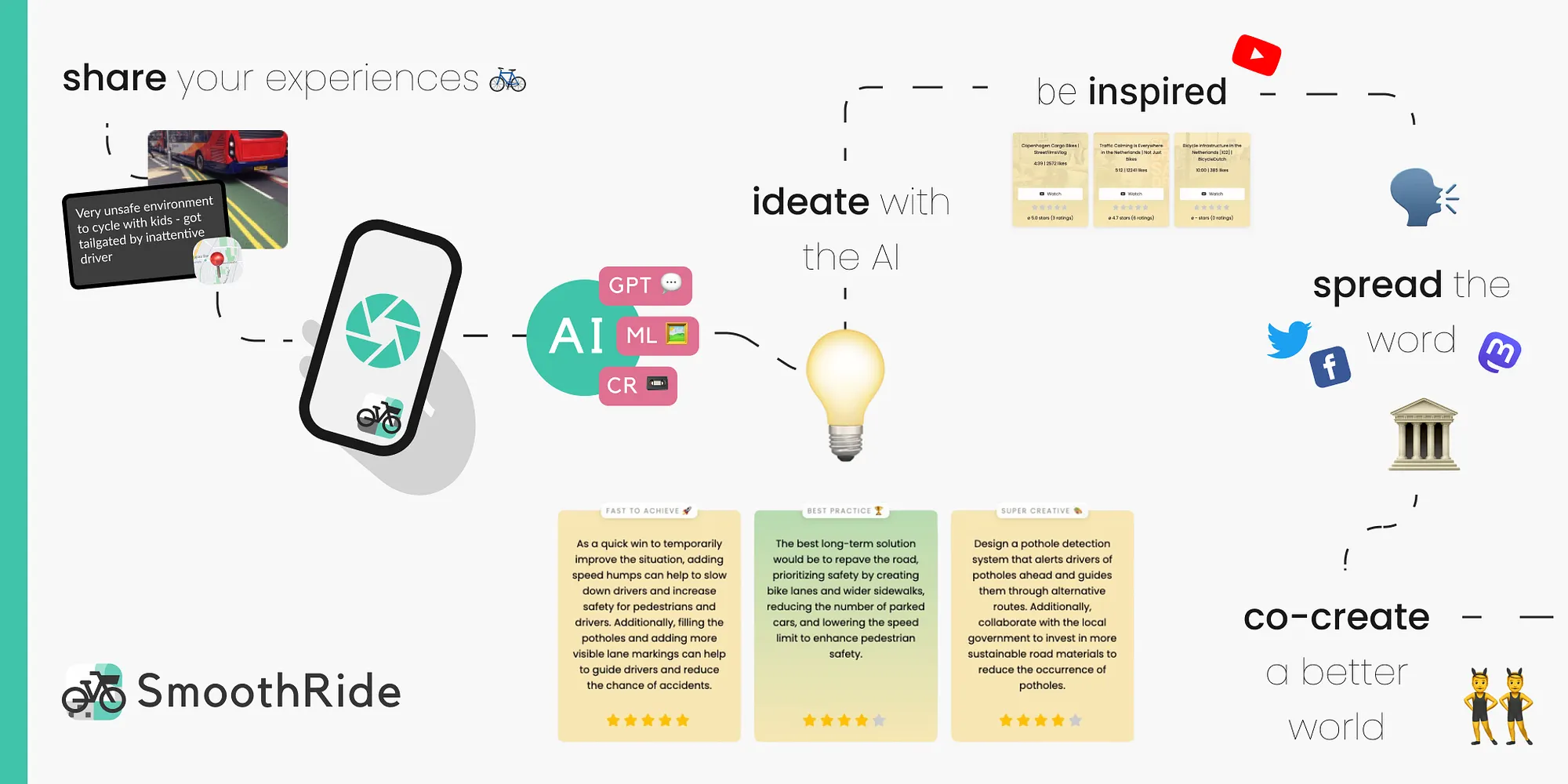
What if citizen engagement could be as intuitive as taking a photo? That's the core insight behind SmoothRide - turning infrastructure into an interface.
Instead of asking people to describe problems in policy language, we start with what they see:
- A photo taken on the street
- Location automatically detected
- Visual tags instead of lengthy forms
- AI-powered suggestions for improvements
- Global examples showing what's possible
Participation shouldn't require expertise - it should reward curiosity.
This approach mirrors what I learned about making cycling Type 1 fun - when something feels effortless and enjoyable, adoption follows naturally. Just as good cycling infrastructure should feel "boring" (safe and predictable), good civic engagement should feel seamless.
The AI Advantage: From Individual Frustration to Collective Intelligence
Here's where it gets interesting. SmoothRide doesn't just collect complaints - it generates possibilities. When someone uploads a photo of a problematic intersection, the AI suggests specific improvements based on:
- Best practices from similar situations globally
- Local context and constraints
- Successful interventions from other cities
- User feedback and ratings
The magic happens when individual experiences become collective learning. Every report teaches the system something new about what works, what doesn't, and what citizens actually want.
This connects to what I wrote about in my shift from car culture to freedom of choice: behaviors are shaped by the accessibility of options in our environments. SmoothRide makes civic participation an accessible option by removing traditional barriers.
My Berlin Experiment: Testing Democracy in Real Time
During development, I tested SmoothRide at cycling events across Berlin - from VeloBerlin to grassroots advocacy meetups. The feedback was consistent: people want to participate, but existing tools feel hostile.
One user put it perfectly: "I see problems every day on my commute, but reporting them feels like homework. This feels like sharing."
That shift from reporting to sharing is crucial. It transforms civic engagement from a chore into a conversation - much like how I experienced the difference between car-dependent Berlin and bike-friendly Netherlands in my journey beyond society's default.
What I Learned: Proximity Drives Participation
The most engaged users were those who could see their reports in context - connected to similar issues nearby, linked to potential solutions, part of a larger pattern. This reinforces something I wrote about in from isolation to innovation: proximity creates empathy, and empathy drives action.
When citizens can see how their individual experience connects to collective challenges, participation feels meaningful rather than futile. It's the same principle that makes coliving work and why cruise ship-like cities create natural community.
Beyond Technology: The Human Infrastructure of Democracy
SmoothRide is built on user experience principles I've refined over years of design work (documented in my UX heuristics):
Design for the Street, Not the Office: The platform works mobile-first, in the moment, in the real world. No forms to remember, no jargon to decode. This mirrors the methods over tools philosophy - the right approach matters more than sophisticated features.
Lower Barriers to Participation: Visual tagging over verbose categorization. Inspiration as a byproduct of engagement. Immediate value without platform lock-in.
Bridge Physical and Digital: Every interaction starts with a real place, connects to global knowledge, and returns value to the local community.
The Network Effect: When Individual Voices Become Collective Power
What excites me most about SmoothRide isn't the technology - it's the network effects. When enough people start sharing their experiences:
- Patterns emerge that individual reports can't reveal
- Solutions spread faster than problems
- Citizens become co-designers of their environment
- Local knowledge meets global innovation
This creates what Jane Jacobs called "eyes on the street" - but updated for the digital age. Instead of just watching, citizens become active participants in urban intelligence.
Just as I learned that GTA taught me about mobility choices by presenting diverse options, SmoothRide presents diverse possibilities for improving our streets - turning abstract policy into concrete, visual alternatives.
AI as Democratic Infrastructure
There's something profound happening when AI helps amplify citizen voices rather than replace them. SmoothRide's AI doesn't make decisions - it expands possibilities. It takes what citizens observe and connects it to what's worked elsewhere, creating a bridge between local experience and global knowledge.
This is AI in service of democracy: augmenting human insight rather than automating it away. It follows the same principle I've applied to working with AI - the human remains in control while technology expands capabilities.
The Empathy Engine: How Proximity Creates Change
Psychology research shows us that distance reduces empathy - both physical and social distance. The further something is from us, the less we care. But SmoothRide creates artificial proximity by:
- Making distant solutions feel local and relevant
- Connecting individual experiences to collective patterns
- Showing how small changes create big impacts
- Turning abstract problems into concrete possibilities
When citizens can see how their daily frustrations connect to solvable challenges, empathy transforms into agency. This is the same mechanism that makes the headphone pandemic so dangerous - it creates artificial distance just when we need more connection.
Beyond Cycling: A Template for Civic Engagement
While SmoothRide focuses on cycling infrastructure, the principles apply broadly - much like how my insights about living small in Europe connect to larger themes about sustainable living:
- Start with experience, not expertise
- Make participation rewarding, not just necessary
- Connect individual voices to collective intelligence
- Use AI to expand possibilities, not replace judgment
This approach could transform how we engage citizens on everything from housing policy (as I explored in from isolation to innovation) to climate adaptation - any domain where individual experience contains collective wisdom.
The Next Phase: From Prototype to Movement
SmoothRide began as a side project, but it's becoming something larger: a template for democratic participation in the digital age. The next phase involves:
- Partnerships with cities ready to experiment with new forms of engagement
- Integration with existing civic tech infrastructure
- Expansion beyond cycling to other infrastructure domains
- Open-sourcing the approach for global adaptation
Conclusion: Democracy as User Experience
The future of citizen engagement isn't about better forms or faster responses - it's about fundamentally reimagining how democracy feels. When participation is intuitive, rewarding, and immediately valuable, citizens don't just comply - they contribute.
SmoothRide proves that the gap between individual frustration and collective action isn't technical - it's experiential. When we design for human needs rather than administrative convenience, democracy becomes something people want to do, not something they have to do.
The next great urban innovation won't come from city halls or consulting firms. It will emerge from millions of daily experiences, connected by technology that amplifies rather than extracts, and guided by AI that expands rather than replaces human wisdom.
We just need to make it possible - and make it feel as natural as choosing the right tool for the job, whether that's a bike for short trips or a platform for civic engagement.
Links and Further Reading:
- Cycling Experience and the Fun Scale
- From Car Culture to the Freedom of Choice
- From Isolation to Innovation
- The Headphone Pandemic
- Cities Like Cruise Ships
- My Favorite UX Heuristics
- Methods Over Tools
- Working with AI
This article builds on themes I've explored around human-centered urban design, the psychology of participation, and how technology can amplify rather than replace human intelligence in creating better cities.