
Some of you might remember "Bike Lanes by Casey Neistat".
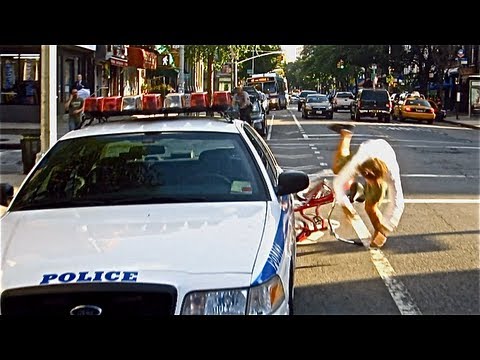
This is Type 3 fun. "Type... what?" you might ask. Let me explain.
The fun scale, quick and painful
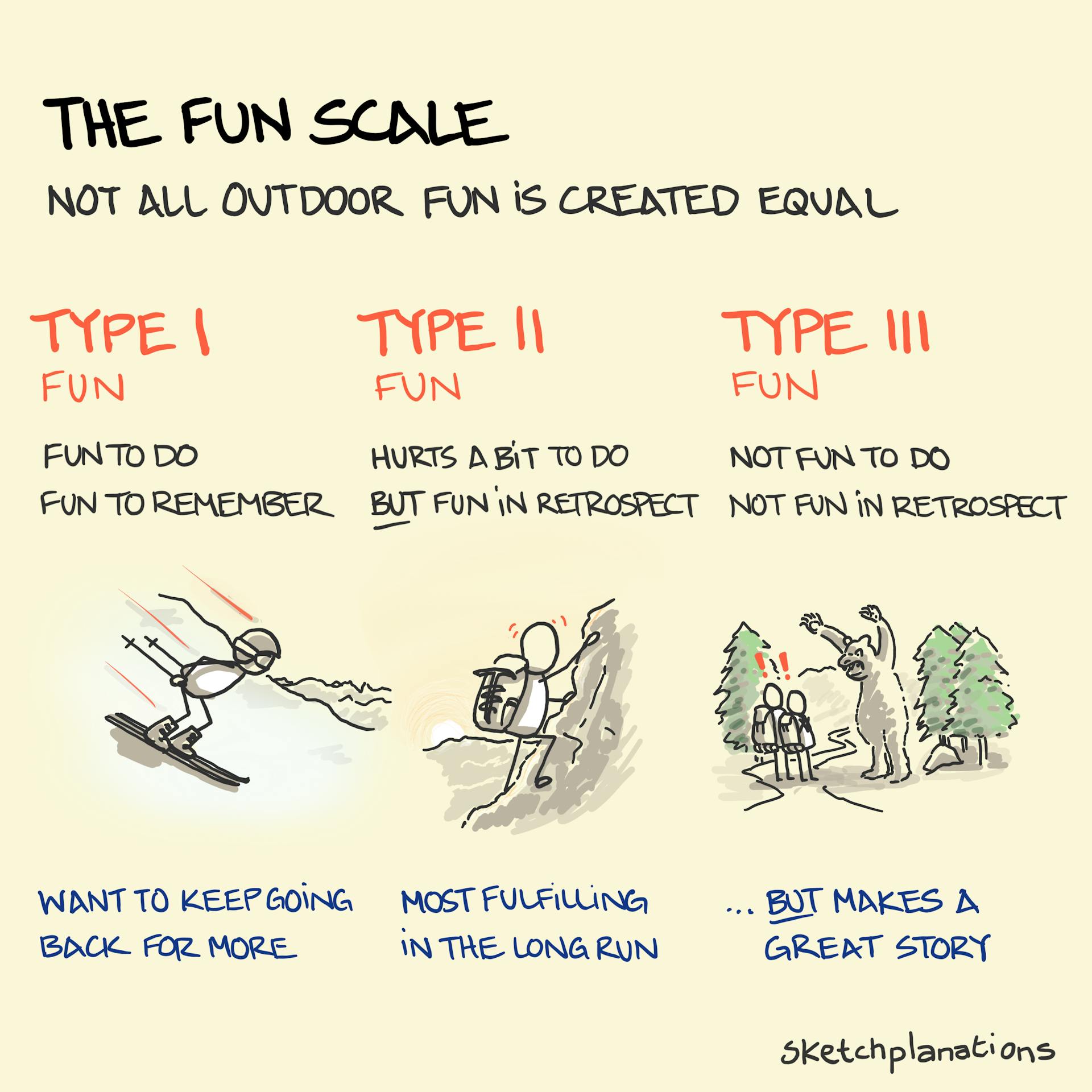
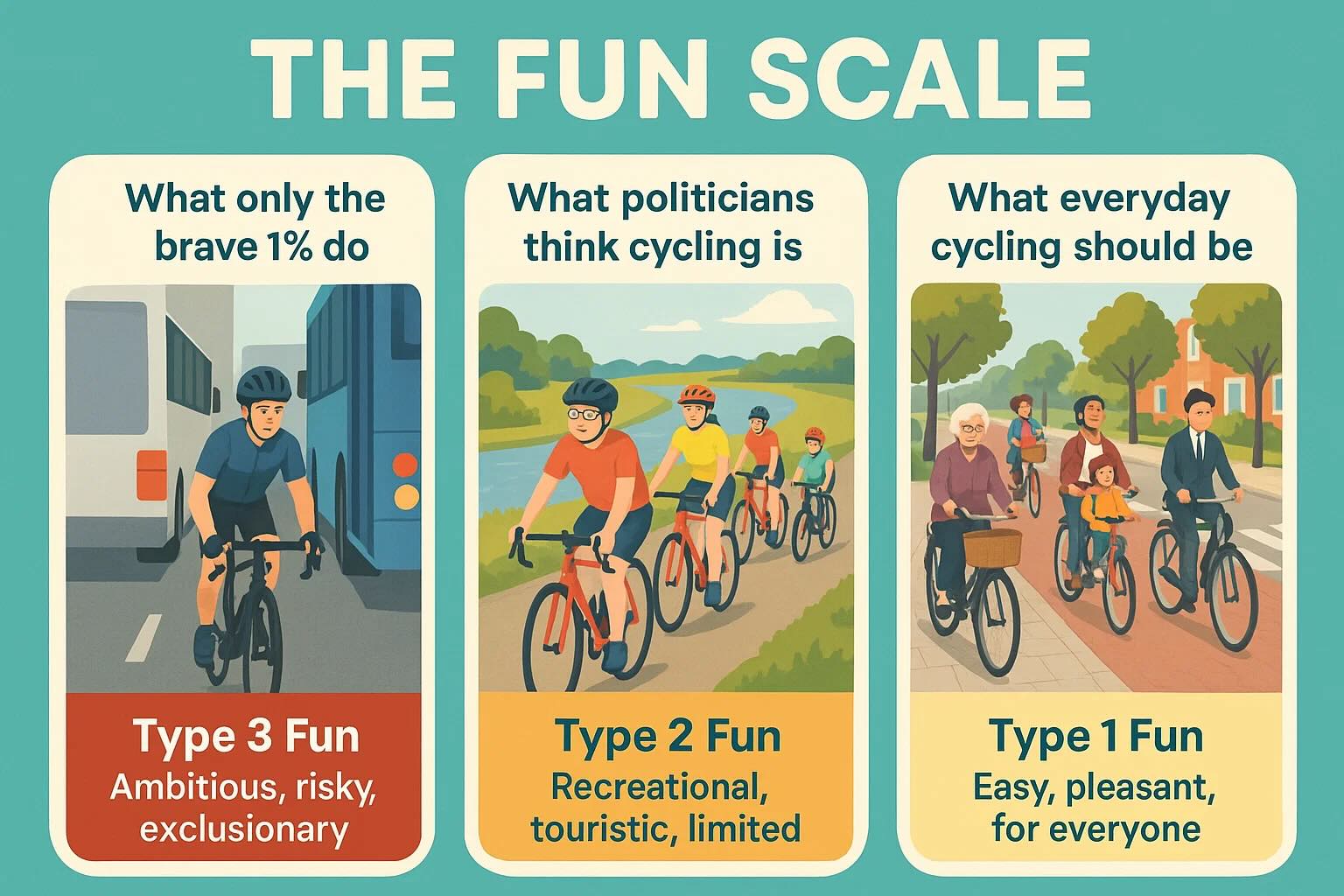
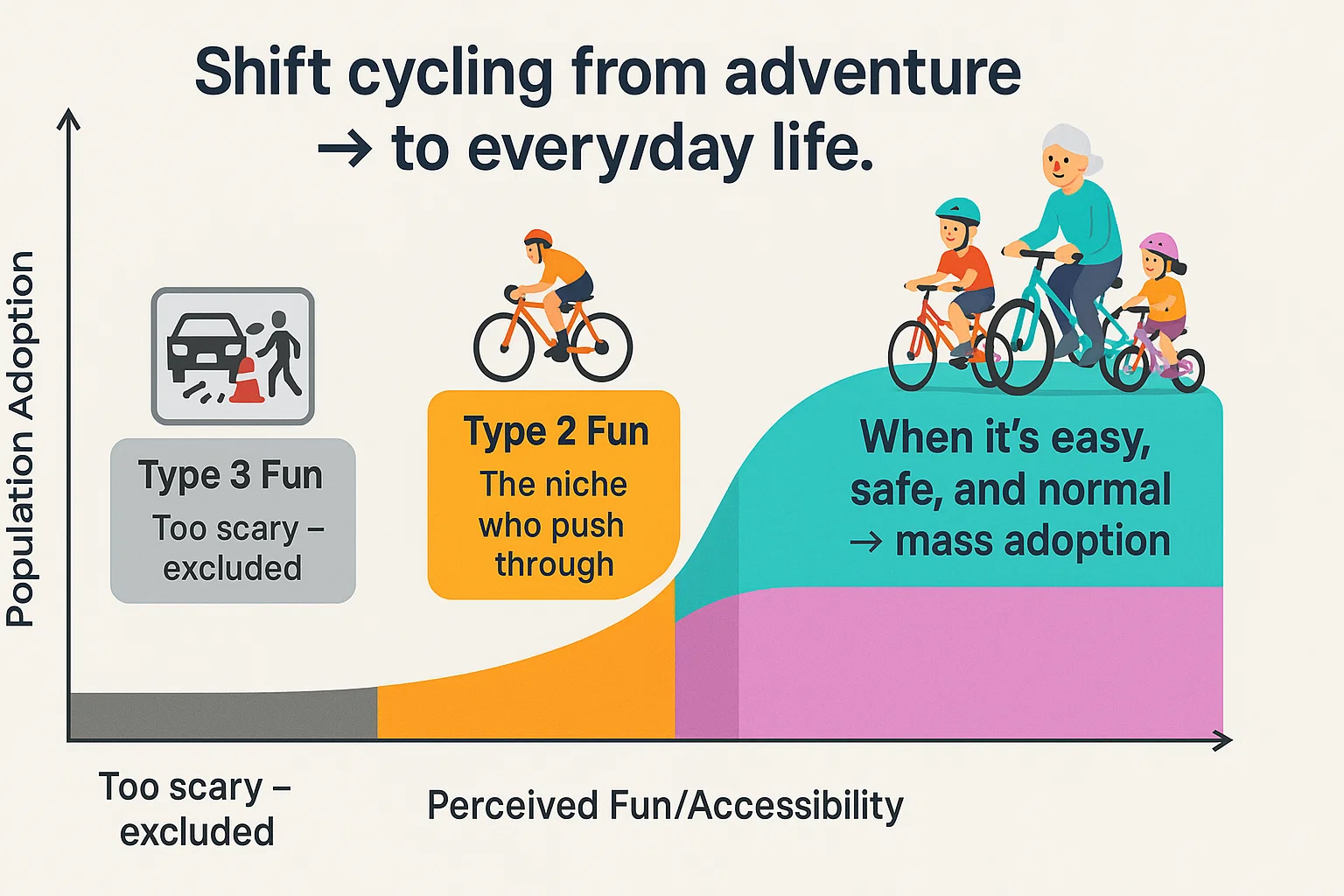
- Type 1: Feels good in the moment - the bike is your magic carpet to the bakery, school or work.
- Type 2: Miserable while it happens, only fun in retrospect - clenching your jaw through traffic. Often has recreational or touristic value (weekend rides, sport), but as a baseline for everyday transport it excludes everyone except the young, fit and brave.
- Type 3: Purely awful - near misses, fear, real danger. No transport value; only intimidation and exclusion.
If cycling in your area still feels like an adventure, it means it has only reached Type 2 at best.
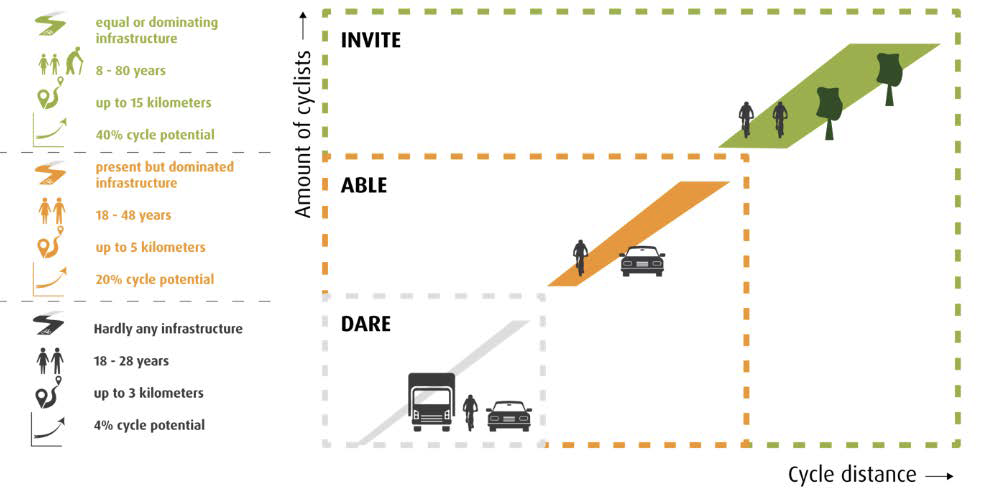
Dare → Able → Invited (the adoption ladder)
Research (van Hagen, Govers & Coffeng, 2019) sums it up: places shift through three stages:
- Dare (Type 3) — only the brave risk‑takers ride. Streets are hostile; cycling is an act of courage or protest.
- Able (Type 2) — rudimentary lanes or routes make trips possible but still stressful. This stage supports enthusiasts or tourists but excludes many everyday users.
- Invited (Type 1) — the city actively welcomes cyclists: safe, continuous, and comfortable infrastructure that enables everyone to choose cycling for daily trips.
Frame the ladder as a progression of inclusion: Dare excludes most people; Able allows some to persist; Invited is where habitual, universal cycling happens. Only "invited" produces mass adoption.
Why cycling looks niche (WTF moments)
- Media sells sweat and spectacle → cycling = sport.
- Politicians parade on bikes once a year for press pictures → they don’t feel daily friction.
- It’s often easier to securely park a two‑ton SUV for free than to secure a €200 bike.
- We treat a kid biking to school like an extreme sport while a 16‑year‑old driving a car is normal.

Gear as "In‑App Purchases"
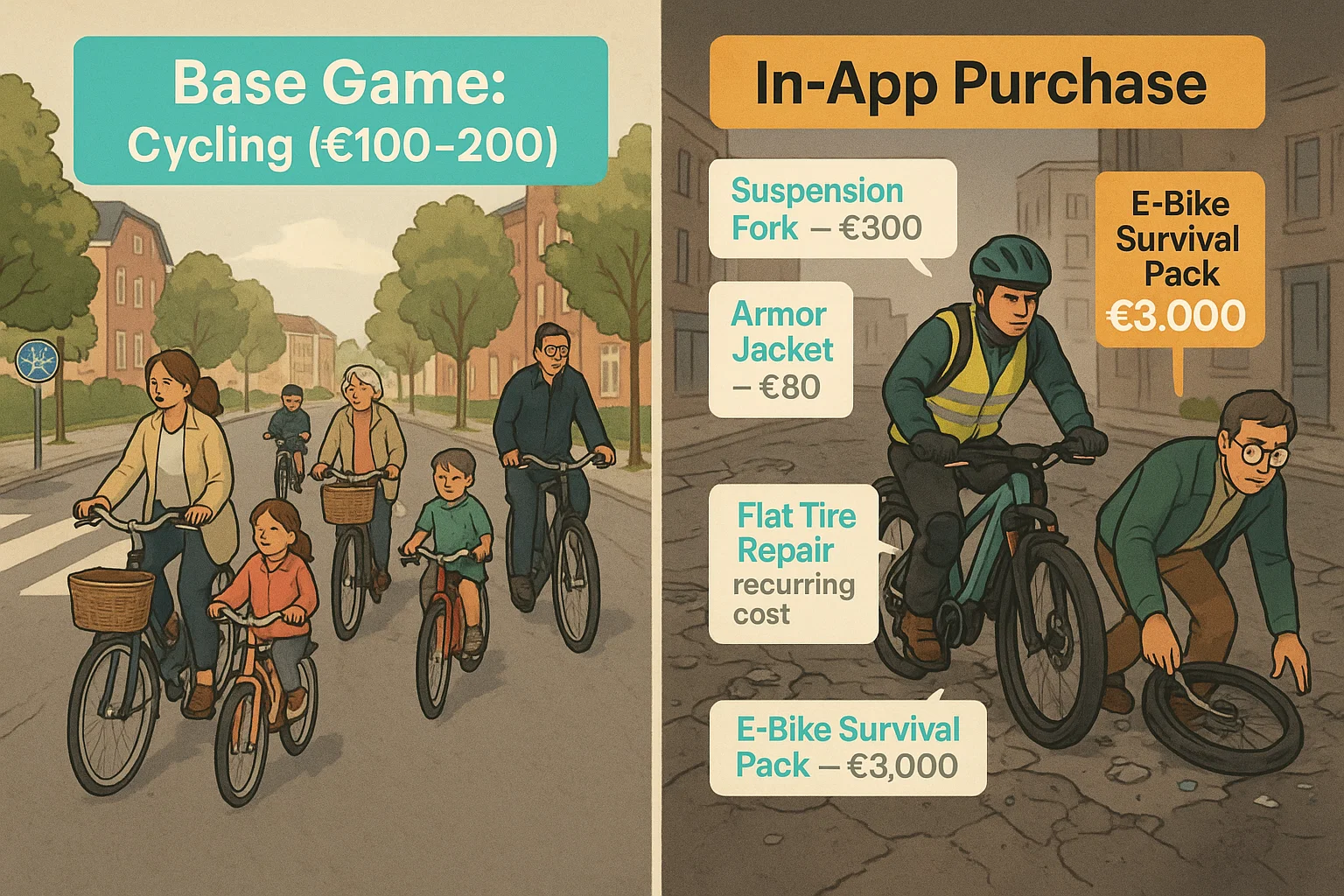
Bad infrastructure gets hidden behind gear. People buy gravel bikes, suspension forks, fat tyres, rain jackets or €3,000 e‑bikes to survive the commute. This can be considered a real-life dark pattern - just like buying body armour to cross your own street.
In places where infrastructural investments were made, regular city bikes can be enough. A bike with a front carrier - the tool for groceries and kids - costs €100–€200 used.
That private spending substitutes for public investment.
 Co-created with AIAbout this imageThis image was co-created with the help of generative AI, with human direction and curation. It is labelled to be transparent about AI-assisted content, in line with the EU AI Act's transparency obligations.Learn more
Safe, continuous infrastructure should be paid for by taxes - not by forcing everyday riders into expensive equipment. And I'm not saying this as a "left-green communist": I just say - if we can build expensive infrastructure for cars, we should also build other infrastructure for other modes - so it can create equity in transportation and even alleviate the traffic in car infrastructure and therby require less car infrastructure. Any political direction can and should support good bicycle infrastructure - even a right-wing nationalist could promote the idea of growing a "healthy nation". Promoting a car-centric, petrolhead-minded "lifestyle" is anything but that.
What Type 1 cycling looks like
Think Netherlands, Copenhagen:
- Continuous, physically separated cycle tracks.
- Safe, clutter‑free intersections and plentiful parking.
- Everyday clothes and everyday bikes.
- Kids, parents, older adults riding without drama.
- Motorists and people on bicycles don't get into conflicts
No Lycra. No theatre. Just ordinary transport that happens to be healthy, cheap and clean.
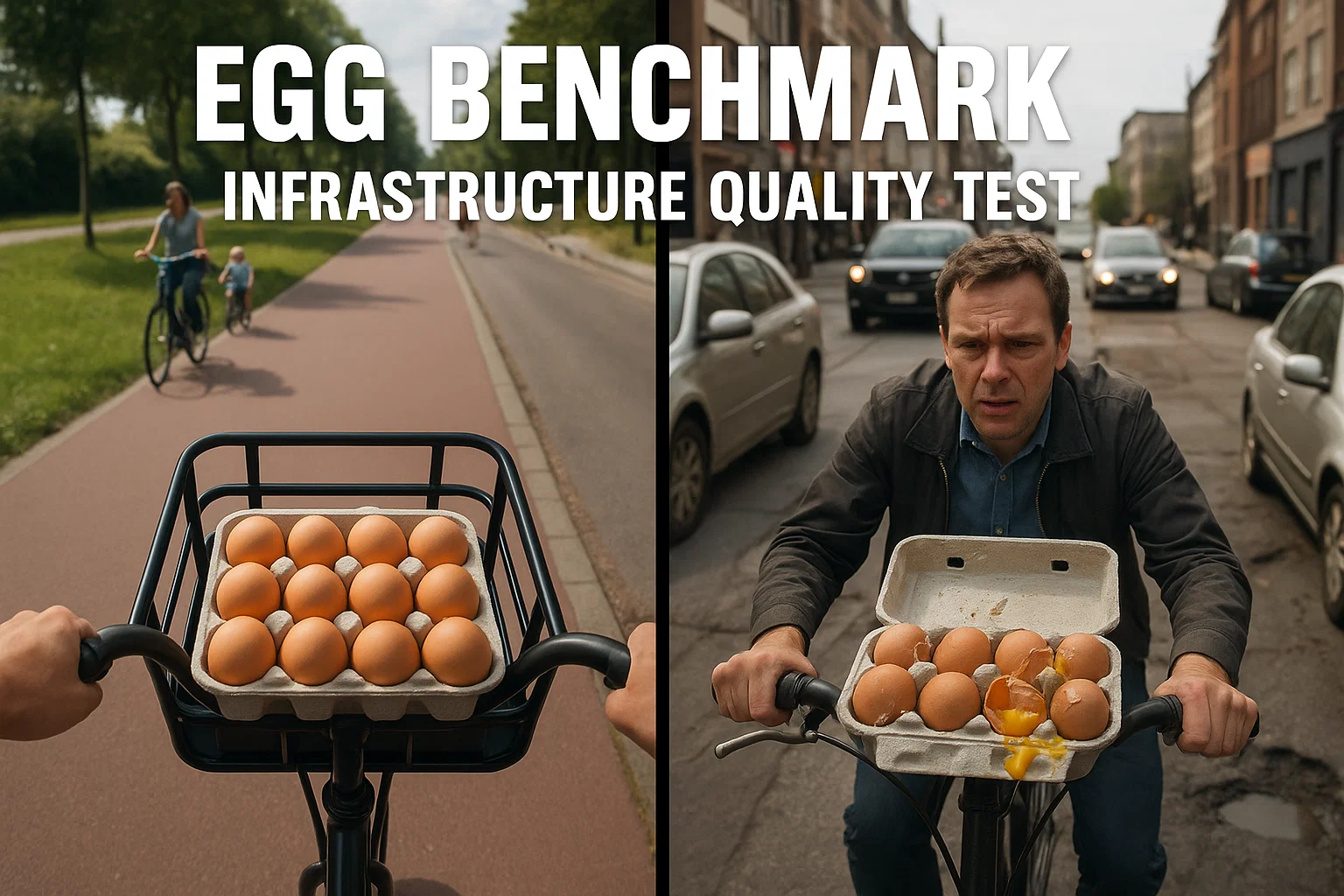
Benchmark: in the Netherlands I regularly carried a carton of eggs in a front carrier and none of them broke — the cycle paths are that smooth, continuous and forgiving.
How to make it fun - The Road to Type 1
Good infrastructure causes adoption, adoption results in less car traffic, more silent streets and healthier air.
- Build continuous, protected, direct networks (prioritise intersections).
- Design for short trips and errands first.
- Provide secure, plentiful bike parking and end‑of‑trip facilities.
- Normalise utility cycling in campaigns - show ordinary people, not athletes.
- Train and invite underrepresented communities; design gender‑sensitive routes.
- Measure perceptions (comfort > tiny speed gains) and iterate.
The test and the call
If cycling still feels like an adventure, it means the place you live in has only reached Type 2 at best.
Make cycling Type 1 fun — ordinary, boring, predictable — and you’ll get extraordinary results: cleaner air, safer streets, healthier people.
For a personal take on swapping car dependence for everyday cycling, read "Shifting Gears: From Car Culture to the Freedom of Choice".
Nairobi - cycling as political resistance
Grassroots movement appear all around the world. Recent reporting from Nairobi frames cycling not just as transport but as a political and cultural act. Grassroots groups such as Critical Mass Nairobi use organised rides to reclaim street space and visibility, while many women describe cycling as autonomy and protest against a car‑first, gendered road culture. The piece documents how scarce, discontinuous infrastructure, social stigma and safety threats shape cycling there, and how community organising and visibility campaigns are changing perceptions.
Original reporting: "In autometropool Nairobi is fietsen een uiting van verzet" - NRC, 11 Aug 2025 This mirrors an important chapter from the Netherlands in the 1960s–70s. The Stop de Kindermoord movement — largely led by parents and especially mothers worried about child road deaths — reframed cycling and street safety as a public‑policy issue, not a private choice. Through local activism, research and political pressure (see De Pijp examples), citizens turned a high‑motorisation, car‑dominated urban landscape into one where design and policy prioritised safe streets for children and everyday cyclists. That history is a useful parallel:
both Nairobi's organisers and the Dutch campaign used visibility, community voice and safety framing to shift public priorities from cars to people.
The Dutch case also reminds us that good cycling infrastructure is not inevitable — it was the product of political will, protest and sustained policy work, not a return to a simpler past.
As a side note: different national trajectories matter. In places with later motorisation (parts of Germany, for example) the politics and infrastructure timelines looked different, and perceptions of safety still push many (especially women) to choose cars for the perceived security they provide.
BUX - Bicycle User Experience (framework)
The Bicycle User Experience (BUX) framework reframes cycling planning around everyday people and their journeys instead of traffic metrics. Practical, applied and training‑focused, BUX offers tools to translate user needs into infrastructure decisions.
Key ideas:
- People‑centered: design for diverse ages, genders, abilities and socioeconomic contexts.
- Four elements of mobility experience: the individual, journey context, specific mode, and infrastructure (see the BUX Mobility Experience Map).
- Focus on touchpoints and perceptions (comfort, continuity, safety) across the whole trip, not only vehicle flow or speed.
- Practical outputs: user‑journey mapping, design checklists, training paths and localisable methods to pick infrastructure that will actually be used.
Use BUX resources and courses to turn inclusive design principles into usable, context‑sensitive interventions.
Further watching: Not Just Bikes
If you’d rather watch than read, Jason Slaughter’s channel Not Just Bikes shows what everyday, Type-1 cycling looks like - and why most other places get it wrong.
A few essentials:
- Why Dutch Bikes are Better (and why you should want one)
- Why City Design is Important (and why I hate Houston)
- Stroads are Ugly, Expensive, and Dangerous (and they’re everywhere)
- Car-Free Streets are Amazing (and we need more of them)
- The Dutch Solution for Safer Sidewalks
(…and honestly, the whole channel is gold if you want to understand how the Netherlands created inclusive road design.)
Conclusion
In short; If your only view of cycling is Lycra, sprint finishes and sweaty commutes, no wonder you think it’s not for you.
In cities where cycling actually works, it’s so reliable people consider it a habitualized nobrainer: calm trips to the bakery, commutes, daycare drop‑offs and grocery runs - not an adventure. Type 1-level fun.
Surprise: In countries like the Netherlands you find people from all political views riding bikes, because it just works - not because they are "green" or "activists".
For a first‑hand experience on my journey of leaving car‑first living behind, see "Shifting Gears: From Car Culture to the Freedom of Choice".
You pay rent for your apartment and taxes for everything around it. Go out and claim your right to safe, comfortable streets where you can get around without fear.
Further reading
- van Hagen, M., Govers, B., & Coffeng, G. (2019). Dare, able and invited to cycle - European Transport Conference. https://aetransport.org/past-etc-papers/conference-papers-2019?state=b&abstractId=6256
- "Benefits, risks, barriers, and facilitators to cycling: a narrative review" (2023). https://doi.org/10.3389/fspor.2023.1168357
- BikeFrames - dataset & code on media framing of cyclists. https://github.com/Zephyr1022/BikeFrames
- Cycling in the Netherlands - overview and stats. https://en.wikipedia.org/w/index.php?title=Cycling_in_the_Netherlands&oldid=1308979429
- How Copenhagen became a cycling city - Tools of Change. http://www.toolsofchange.com/en/case-studies/detail/752