Digital Garden
End of the line: why Deutsche Bahn's vegan currywurst had to go
Germany's railway dropped its vegan currywurst. What's left shows how menus quietly ration choice, and why protein per euro tells the real story.

For a few years, Germany's long-distance trains offered something close to culinary equality. The currywurst – sliced sausage in curry ketchup, a national comfort food and the most reliable smell in any open-plan carriage – came in two versions on Deutsche Bahn's ICE trains: pork or pea protein. Same sauce, same side, and by 2025 the exact same price.
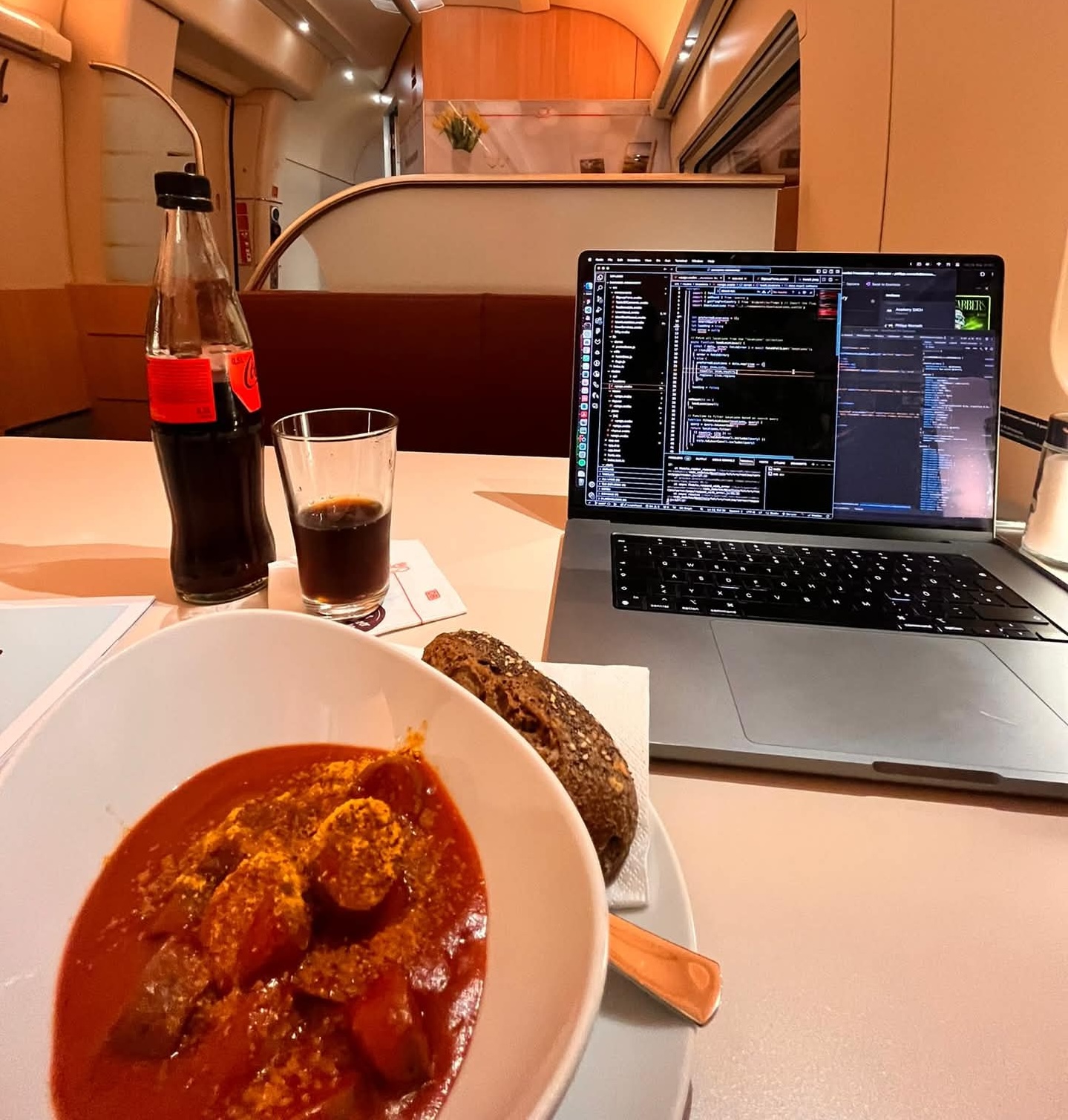
Now the vegan one is gone. Not as a dying niche product, but as what it last was: a bestseller.
A short obituary
The vegan currywurst started as a test during "Veganuary" in January 2023. It sold so well that Deutsche Bahn announced on 31 January it would join the permanent menu from March. 1 At the time, one commenter called the move "discriminatory" towards passengers who wanted a "real" currywurst – even though both versions were sold side by side. 1
On 1 June 2026, with a new on-board menu, it was dropped. A company spokesperson cited declining sales and limited storage space on board. 2 No public figure backs the decline. DB is happy to share numbers when they help: the new potato wedges reportedly sell almost twice as well as the old fries, and around 600,000 currywurst portions go over the counter each year. 3 How many of those were vegan, nobody says.
To be fair, DB is removing freezers from many bistro cars by the end of 2026, partly because of new EU rules on refrigerant gases. 3 So storage is not a pure excuse. But in the same month, the entire wine and sparkling wine selection became vegan. 2 Plant-based, it seems, is welcome where it doesn't take up a plate.
Core finding 1: the gap is in the snacks
Vegan main courses still exist: Chili sin Carne and a Red Thai Curry. The problem sits in exactly the category the currywurst lived in – the quick, warm bite you grab at the counter between two stations.
Here is the count of warm, savoury options under €8 on the July 2026 menu, including the seasonal promotions: 4
| Meat/fish | Vegetarian | Vegan |
|---|---|---|
| 5 options (e.g. organic Fleischkäse roll €5.90, currywurst with tortilla crunch €7.90) | 2 options (both cheese-based) | 1 option: potato wedges with dip (€5.90) |
Five versus one. And the one is a side dish: barely any protein, nothing that keeps you full until the next change of trains. The September 2026 menu didn't change that picture – the wedges are still the only vegan snack, and not a single seasonal promotion dish was vegan in July or September. 5
Archived menus show this wasn't slow erosion. From at least December 2023 to September 2025 there were two warm vegan snack dishes (the currywurst and a wrap); 6 7 by July 2026 there were none. 4 In September 2025, the vegan currywurst still cost exactly the same as the pork one (€7.90 or €10.90, depending on the side). 7 The main courses tell a similar story: three out of four were vegan in September 2025; 7 in 2026 it's two out of five, or two out of six if you count a potato stew with pork belly. 4 5 That's not a trend line. That's a decision.
Core finding 2: protein per euro
DB publishes ingredients and allergens, but no nutrition data. 4 So the following is my own rough estimate based on typical profiles of similar dishes, not an official number. On the current menu, the remaining vegan options cost an estimated €0.69 to €1.18 per gram of protein (Chili sin Carne at the low end, wedges at the high end), while the pork currywurst and the chicken curry land at roughly €0.40 to €0.43.
Compare that with smoked tofu from a German drugstore: €1.55 for 200 g, 13 g of protein per 100 g. That's about 6 cents per gram of protein – at retail price, margin included. It also keeps unrefrigerated in its original packaging, according to the manufacturer. 8 This is not a 1:1 comparison: it sets the shelf price of an ingredient against the on-board price of a served dish. It shows the order of magnitude of the gap, not its exact size.
Which leads to the simplest possible fix: a tofu roll. An organic bread roll, sliced smoked tofu, the same mustard selection DB already offers with its Fleischkäse (Bavarian meatloaf) roll. No freezer needed, no new recipe risk, comfortably priced in the €5–7 range where today only meat snacks live. The autumn promotion, with its Fleischkäse and Bosna sausage rolls, would have been the obvious moment. I did consider bringing my own tofu and just ordering a bread roll. But bringing your own food into the restaurant car simply isn't done.
Why it matters beyond one sausage
Nobody banned anything. Vegans can still eat on DB trains – if they sit down, have time, and pay more per gram of protein. That's the point: unequal treatment rarely looks like a prohibition. It looks like defaults. What's warm, cheap, fast and right at the counter is what most people eat, and that slot is now reserved for meat.
Even the labelling plays along. Vegan dishes are no longer marked with a green "vegan" label but with a small symbol – and DB itself admits this may make the plant-based range look smaller. 2 That is choice architecture in its purest form: nothing is taken away, it just gets a little harder to see and a little less convenient to choose.
For me, taking the train is about sustainable, low-carbon travel – the very promise DB advertises. That makes the imbalance on the menu stand out even more. Closing the gap wouldn't require removing a single meat product. It would just require putting one more thing next to it.
Rest in peace, vegan bistro sausage. You were proof that you don't have to take something away from someone to give something to someone else.
Sources
Transparency note: This is a condensed English version of the much longer German original, which goes deeper into the menu data. AI was used as an assistant for structuring, data analysis and translation.
Footnotes
- t-online, 31 January 2023, referencing Deutsche Bahn's tweet (@DB_Presse) of the same day: "Deutsche Bahn: Vegane Gerichte kommen dauerhaft ins Bordbistro" (German) ↩ ↩2
- vegconomist, 5 June 2026: "Deutsche Bahn nimmt vegane Currywurst aus dem Bordrestaurant-Sortiment, Wein- und Sektangebot ab Juni vollständig vegan" (German) ↩ ↩2 ↩3
- VOL.AT, 22 June 2026: "Pommes-Aus bei der Deutschen Bahn: Currywurst künftig nur noch mit Wedges" (German) – on freezer removal by end of 2026, ~600,000 currywurst portions per year and EU refrigerant rules ↩ ↩2
- DB Fernverkehr AG Bordservice: "Zutaten und Allergene des aktuellen Speisenangebotes", on-board menu from 29 July 2026 (PDF, own analysis) ↩ ↩2 ↩3 ↩4
- DB Fernverkehr AG Bordservice: "Zutaten und Allergene des aktuellen Speisenangebotes", on-board menu from 29 September 2026 (PDF, accessed 15 October 2026): https://db-bordgastronomie.de/dbgastro/downloads/DB_Zutatenheft_aktuell.pdf ↩ ↩2
- Internet Archive Wayback Machine, db-bordgastronomie.de, snapshot of 10 December 2023: https://web.archive.org/web/20231210161109/https://www.db-bordgastronomie.de/ ↩
- Internet Archive Wayback Machine, db-bordgastronomie.de, snapshot of 7 September 2025: https://web.archive.org/web/20250907183959/https://db-bordgastronomie.de/ ↩ ↩2 ↩3
- dm-drogerie markt: product page "dmBio Tofu, geräuchert, 200 g", price €1.55, nutrition facts and "keeps unrefrigerated" note: https://www.dm.de/p/d/1503058/dmbio-tofu-geraeuchert, last checked September 2026 ↩