
When people ask how I became a designer, they often expect me to point to a university course, a mentor, or a pivotal first job. But the truth is: my earliest lessons in design, mobility, and human experience came not from a classroom - but from games.
Growing up, three titles in particular taught me principles that I still apply in my professional work today: Roller Coaster Tycoon, The Sims, and Grand Theft Auto: San Andreas. Each one, in its own way, trained me to see systems, people, and possibilities differently.
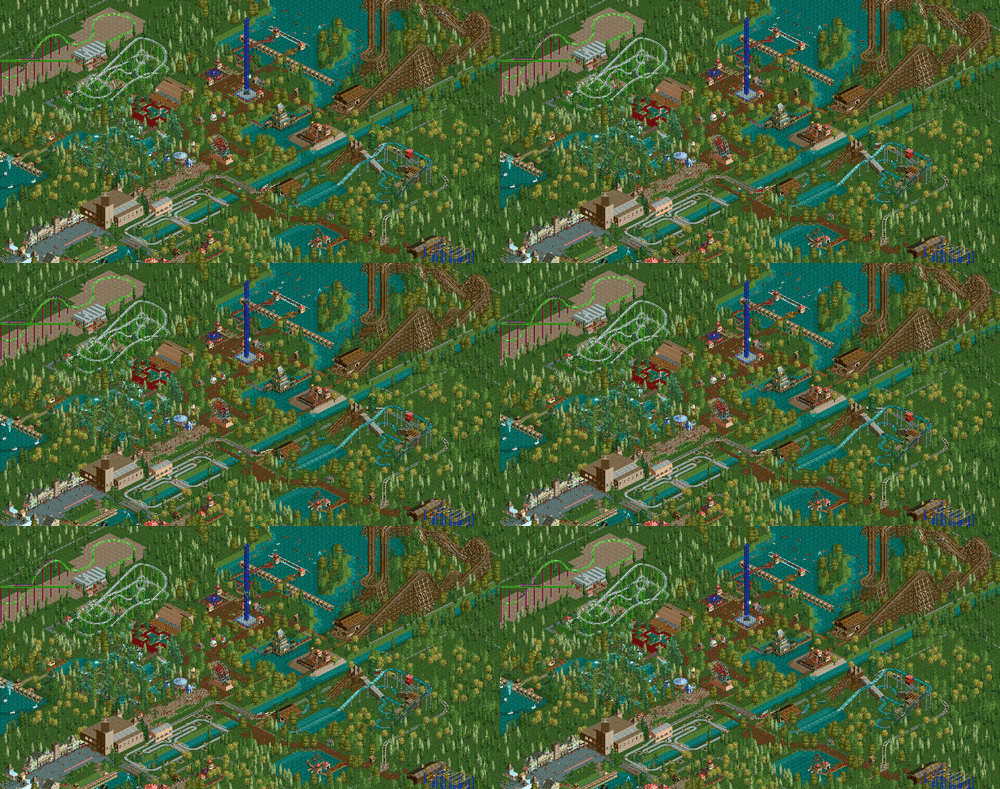
Roller Coaster Tycoon - The Joy of Designing for Others
Long before I knew the term “user experience,” I learned that good design is about satisfaction, not just aesthetics.
I spent hours fine-tuning parks not just for looks, but for performance. RCT introduced me to metrics before I even knew what KPIs were:
- User feedback & origins: Reading guests’ thought bubbles (“I’m not paying that much for a burger!”) and tracing complaints back to where they occurred.
- User flows: Optimizing path layouts so people didn’t get lost, bottlenecked, or stuck in endless loops. Balancing walkable distances, fun, and scalability was basically urban design in miniature.
- Profit per attraction: Seeing which rides generated revenue and which were just vanity projects.
- Pricing strategy: Testing whether lowering ride entry by 50 cents increased traffic more than it cut margins.
- Marketing & R&D: Investing in campaigns to promote a new coaster, or funding research to unlock new ride types - classic portfolio strategy.
Last weekend, I booted up the game again through OpenRCT2 (highly recommend!) - and instantly fell back in. Within minutes I was deep into flow state, juggling feedback, iterating layouts, and tweaking prices. It reminded me why this game grabbed me in the first place: it wasn’t just play, it was an early apprenticeship in systems design.
Looking back, this also explains why people often call me a “unicorn” in my discipline: I combine creative design with an obsession for data, metrics, and flows. RCT was the first place I learned to blend artistic vision with business acumen and operational detail.
The Sims - Building Communities and Meaningful Interactions
The Sims wasn’t just a house-building game - it was a sandbox for understanding architecture, social interaction, and community design.
Through it, I discovered:
- Architecture as Interaction: A well-designed space shaped how Sims moved, connected, and thrived.
- Accessibility and Comfort: Adding ramps, furniture, or lighting wasn’t cosmetic; it determined whether life in that virtual world felt frictionless or frustrating.
- Relationships & Communities: Success wasn’t measured in wealth but in how fulfilled Sims felt through friendships, family bonds, and community ties.
Looking back, The Sims was my first exposure to human-centered design - the realization that environments must support people’s needs, emotions, and interactions.
GTA: San Andreas - Rethinking Mobility and Multimodality
On the surface, Grand Theft Auto: San Andreas was about chaos and freedom. But underneath, it was my first mobility sandbox.
I experimented with different modes of transport - cars, bikes, trains, planes - not realizing that I was exploring the foundations of multimodal mobility years before it became a professional focus.
- Carsharing & Resource Use: Sometimes stealing a car wasn’t about rebellion - it was about efficiency. Why own when you can share, borrow, or hop on public transport?
- Multimodality: Switching from bike to car to plane made me realize how important seamless connections are in real mobility systems.
- Business Systems: San Andreas was also about side hustles, ownership, and economy. From buying properties to running businesses, it subtly introduced me to entrepreneurial thinking.
What stayed with me is the notion that mobility is freedom - but true freedom requires access, choice, and connectivity.
Why I Never Enjoyed Pure War or Single-Modal Games
Looking back, I also understand why certain games never kept my attention.
Pure shooters, racing games, or football titles bored me after a while. They offered adrenaline, but not systems. They were single-modal, narrowly focused, and lacked the interconnectedness I craved.
What kept me hooked on Roller Coaster Tycoon, The Sims, or San Andreas wasn’t just the fun - it was the layered complexity: the mix of design, mobility, relationships, and business all woven together.
That complexity has also evolved with me. As Kyle Orland recently wrote in Ars Technica’s 30-year retrospective on SimCity 2000, the same games can hit us differently as adults. Where as children we might crank taxes up for fun or unleash disasters just to watch chaos unfold, adulthood brings empathy for the tiny citizens - we start thinking about budgets, fairness, livability, and trade-offs.
And the comments on that piece show how universal this is:
- One reader noted, “SimCity 2000 is one of the biggest reasons that I became a civil engineer… If only real life was as simple as the game made it out to be!”
- Another pointed out the bias baked into the simulation, especially its car-centric design: parking barely appears, while in reality it dominates our cities’ surface area. As transport scholar Jarrett Walker wrote, games like SimCity unintentionally “greenwash” urban design by glossing over the true cost of cars.
These reflections remind me that while games shape imagination, they also simplify. They spark curiosity - but they need to be challenged with reality.
From Games to Profession
Today, I design experiences at the intersection of mobility, technology, and human behavior. When I trace back the skills I use daily - balancing user satisfaction with business goals, designing inclusive systems, and thinking about multimodal futures - I realize they were all seeded by these childhood games.
Games didn’t just entertain me; they trained me to think in systems, empathy, and possibilities. They showed me that every design - whether a roller coaster, a home, or a city’s mobility network - is ultimately about how people experience the world.
And maybe that’s the greatest game of all: designing for real life.